Enterprise AI Readiness: How to Decide Whether a Pilot Can Scale
Explore our AI pilot testing framework against real-world conditions, including infrastructure, connectivity, users, and governance, before scaling.

A successful AI pilot can indicate that an idea works, yet does not necessarily indicate that the organization should scale it.
That distinction matters as mature enterprises and institutions move from AI experimentation into larger operational programmes. A pilot may perform well under controlled conditions while important questions about infrastructure, users, cost, governance, and long-term ownership remain unresolved.
AI pilot testing can therefore be treated as a scale-up decision process, not only an engineering evaluation.
This distinction is also reflected in UNDP's 2026 analysis of AI adoption across 26 country assessments: “readiness is tested through implementation.”
This blog presents a practical use case of an AI readiness framework to help institutions evaluate four areas before scale-up: deployment assumptions, user access and adoption, operational resilience, and organizational readiness.
1. Validate Assumptions Behind AI Deployment
A lot of AI pilots are built on assumptions.
Users will have suitable devices. Connectivity will be available. Required data will be accessible. Systems will integrate as expected. Response times will remain acceptable. Users will interact with the system in predictable ways.
Controlled pilots can make many of these conditions easier to manage. Before moving on to a wider AI deployment, the organization should determine which assumptions have actually been validated under representative operating conditions.
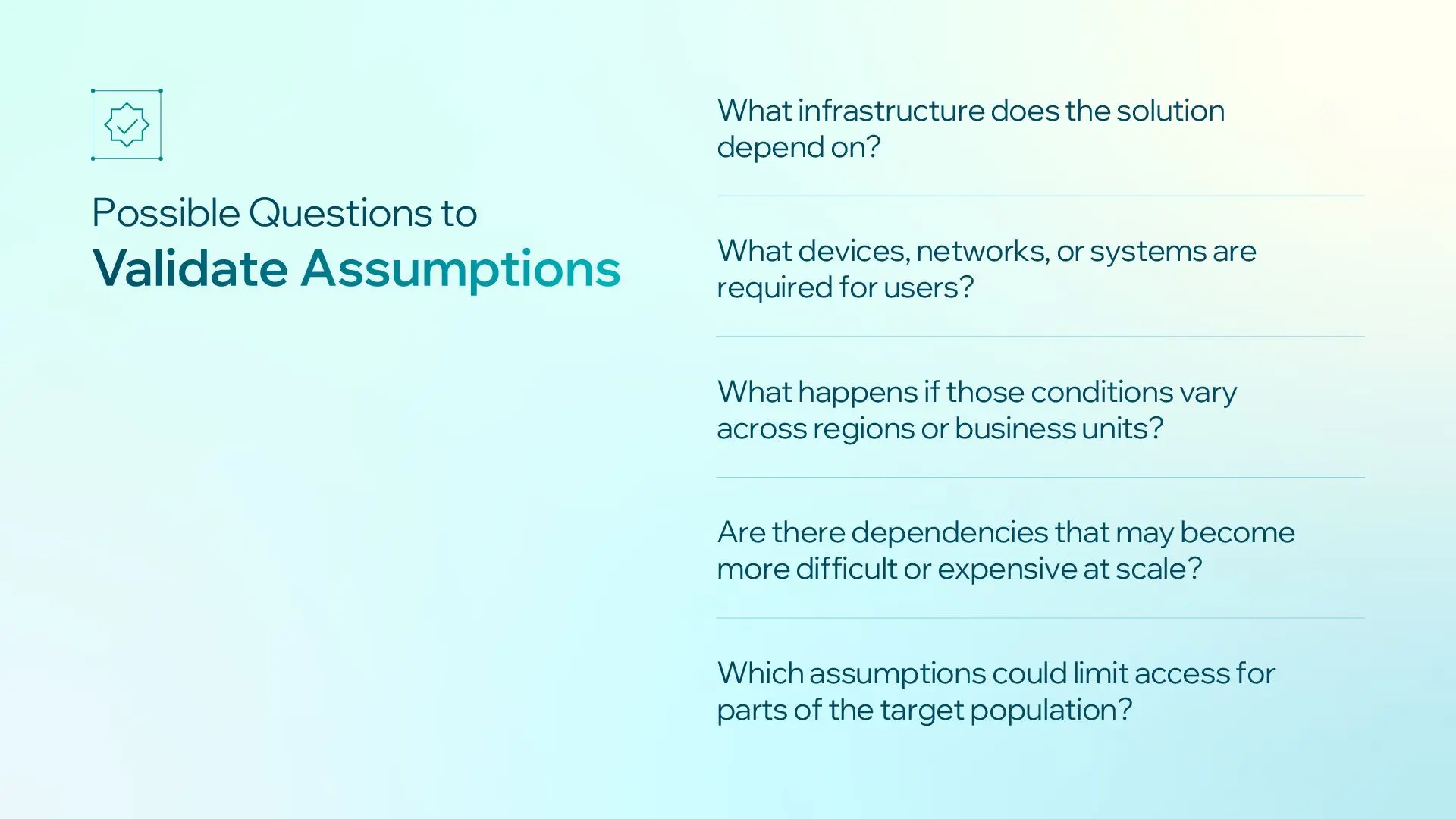
Leaders should also identify which pilot decisions may become difficult or expensive to reverse at scale.
A dependence on one cloud platform, vendor, data source, integration, or manual process may be manageable for 100 users. It can become structural once it is embedded across contracts, architecture, workflows, and thousands of users.
The aim is not to eliminate dependencies. It is to make the important ones visible early enough to manage them deliberately.
2. Evaluate Whether AI Can Serve Its Intended Users
As Kris, our Product Owner, shared in a recent podcast,
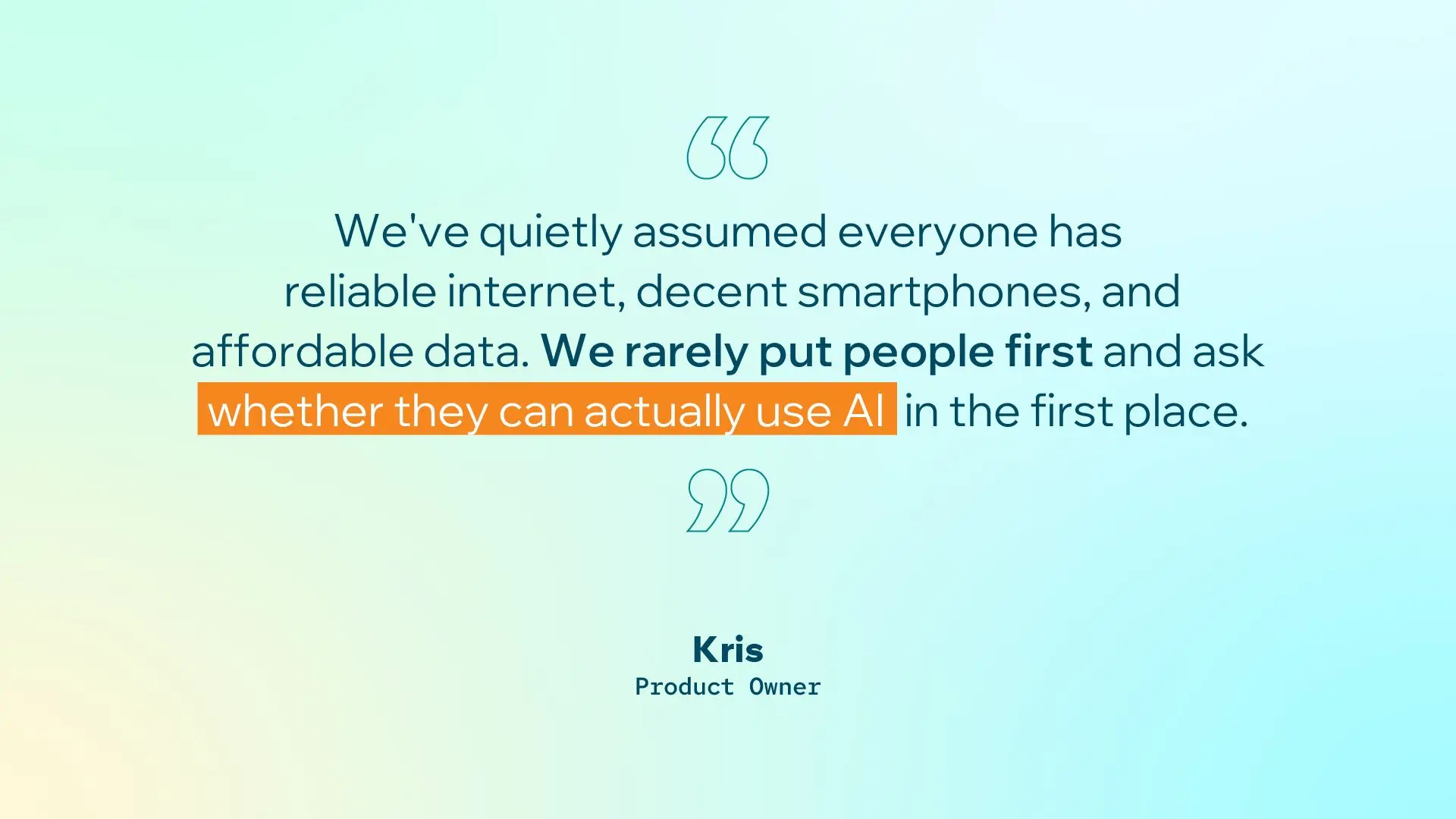
A technically capable system creates limited value if significant parts of its intended audience are unable to use it reliably. The barriers will vary by deployment context:
-
For enterprise programmes, barriers may include authentication complexity, integration into existing workflows, device compatibility, network restrictions, or employee adoption.
-
For public-sector or development programmes, the constraints may extend further to connectivity, data affordability, shared devices, language, digital literacy, or access to modern hardware.
-
For logistics and field operations, usage conditions may include intermittent connectivity, shared or rugged devices, mobile work environments, time-sensitive workflows, and integration with operational systems across warehouses, vehicles, or remote sites.
These conditions affect not only user experience, but also the potential impact of the investment.
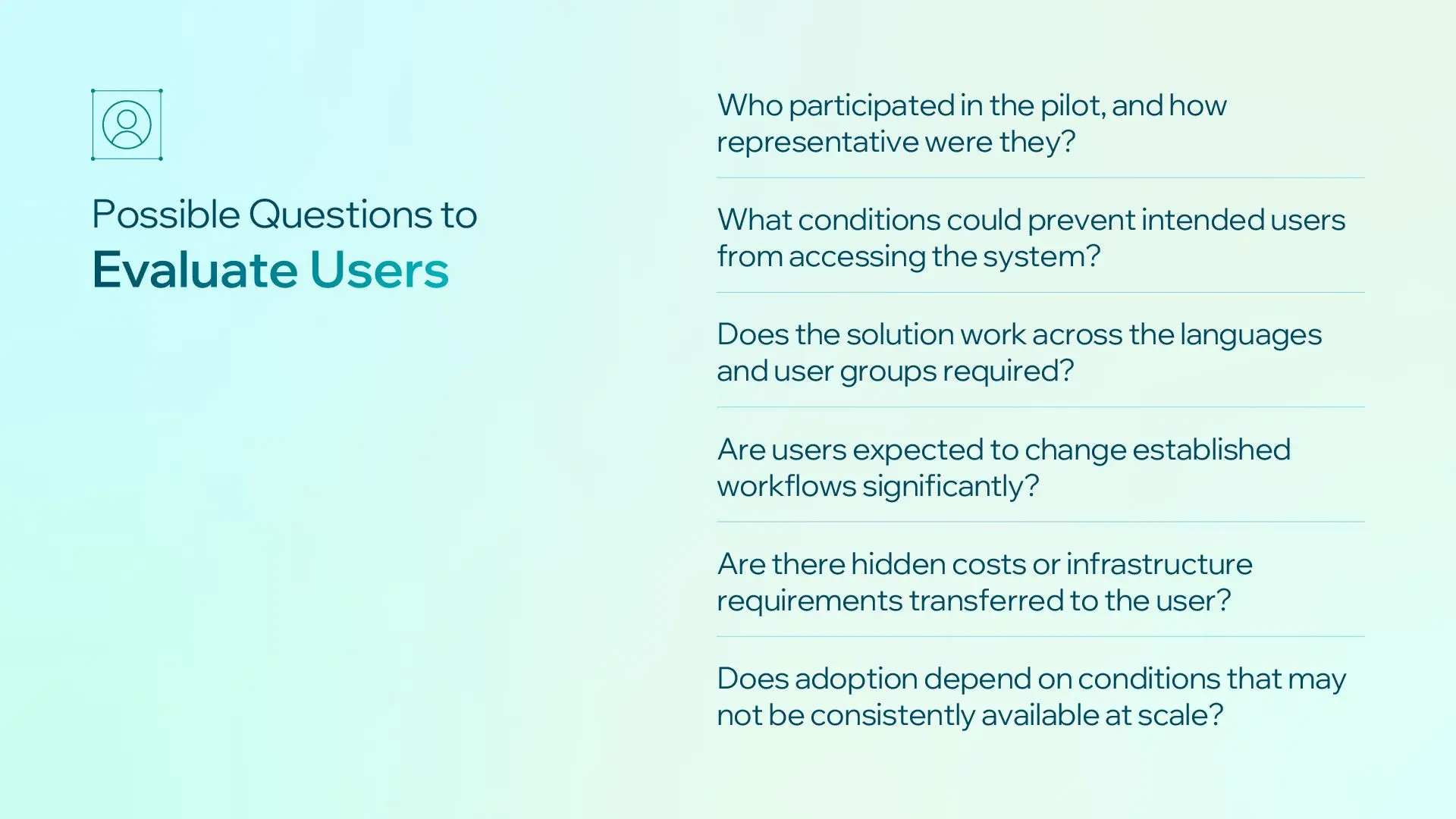
This is especially relevant when AI programmes are intended to expand access or improve institutional service delivery. In those contexts, a high-performing system that works only for the most connected users may technically succeed while not fully meeting the programme objective.
3. Test Whether the Programme Can Absorb Real-World Failure
Pilots usually focus on demonstrating successful workflows. Production environments introduce more variation: integrations may fail, information may be unavailable, networks may drop, users may make unexpected requests, and external systems may change.
The institution does not need to eliminate all such risks before scaling. Nevertheless, the programme should still be able to absorb them without unacceptable operational consequences.
This may include scenarios such as service interruption, unavailable upstream data, incomplete transactions, incorrect AI responses, failed updates, or degraded infrastructure.
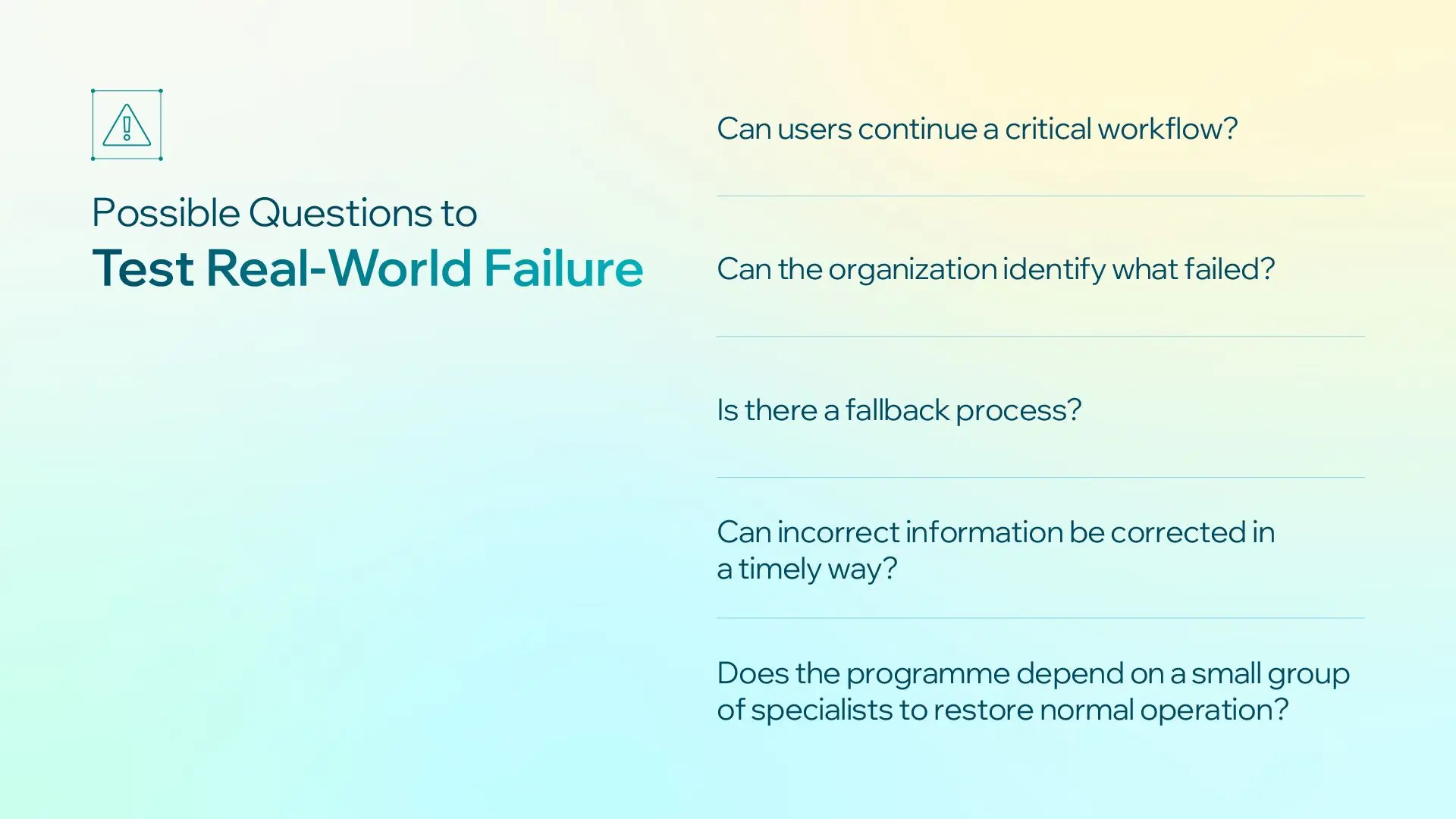
These AI pilot testing questions become increasingly relevant when AI moves into customer-facing, regulated, mission-critical, or high-volume workflows.
Policies and AI principles matter, but at scale they need to translate into monitoring, vendor responsibilities, escalation, correction, and accountability.
4. Confirm the Organization Is Ready to Operate the AI at Scale
Many AI pilots succeed because the project team provides an unusually high level of attention.
Specialists monitor performance closely. Vendors resolve issues quickly. Content is manually maintained. Technical teams intervene when integrations fail. Decisions are made within a small pilot group.
That operating model may not scale directly.
Before approving wider deployment, leadership should establish who is expected to own the system once it becomes part of normal operations.
That includes responsibility for:
-
performance monitoring
-
approved knowledge and data
-
model or application updates
-
security and governance
-
user support
-
incident escalation
-
vendor management
-
ongoing programme outcomes
The issue is particularly relevant when external AI integration partners support the pilot.
A partner can provide engineering expertise and help establish governance mechanisms, but the deploying organization still typically needs sufficient ownership to maintain the system over time.
This is where AI readiness becomes an operating-model question.
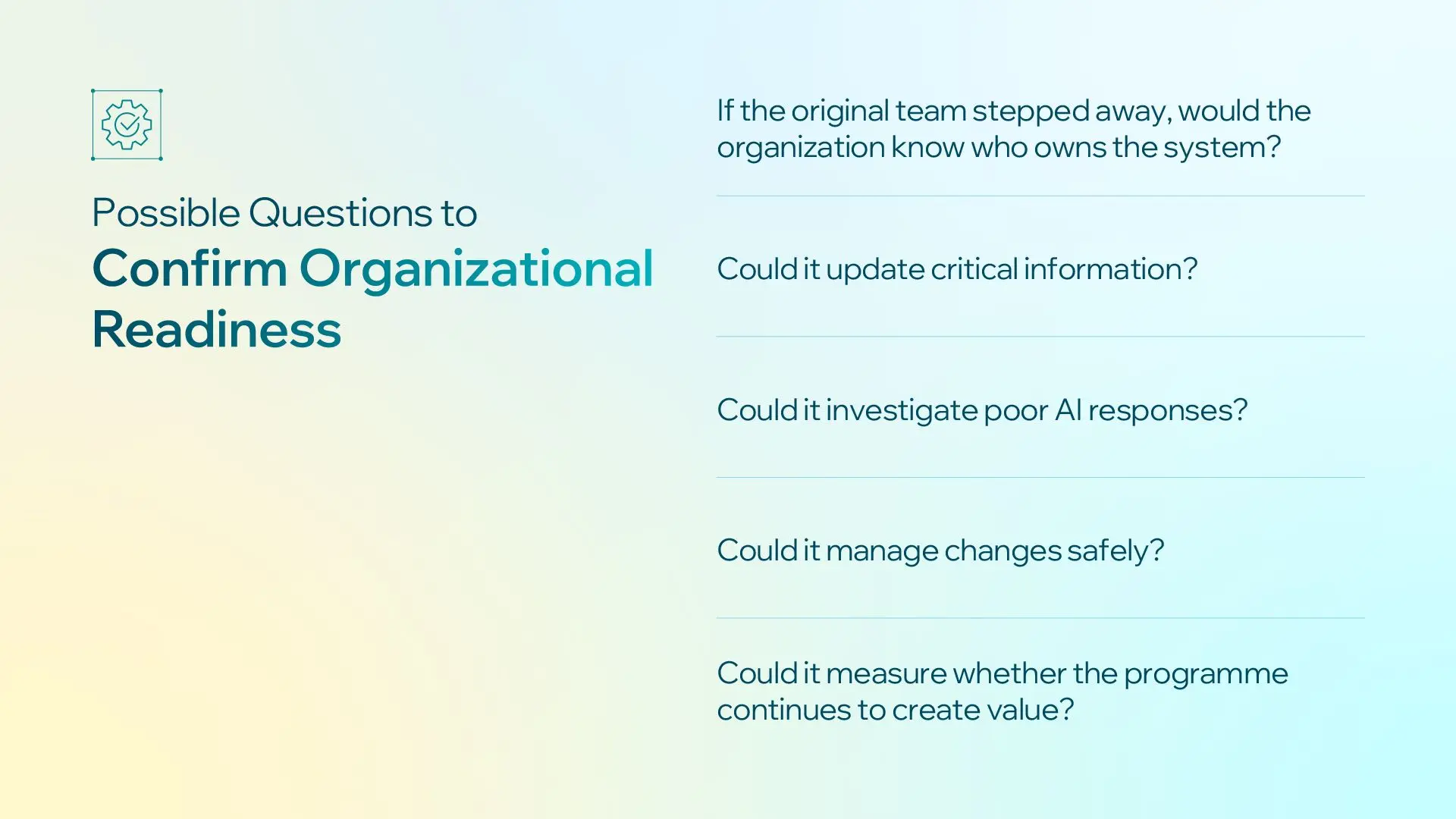
If these responsibilities are not yet clearly defined, and every new use case requires the organisation to rebuild its governance, evaluation, operating processes, and supplier controls from the beginning, the technology may be closer to production readiness than the organization is.
Use AI Readiness as a Scale-Up Decision Gate
These four areas give leaders a more practical basis for deciding whether an AI pilot is ready to scale. The thresholds will vary by use case and risk, but the principle remains the same: production decisions should be based on evidence from real operating conditions, not only controlled pilots.
Our white paper, Bringing AI Within Reach, explores this challenge further through the lens of low-connectivity environments and shows how field conditions can shape AI deployment decisions.

CodeLink
Founded in 2016
We partner with enterprises and institutions to turn complex technology challenges into reliable digital systems through expert software engineering, AI implementation, and disciplined delivery.